
Creator routines work better because they automate repetitive decisions, reduce anxiety, and protect dedicated time for deep creative work. The term "creator routine" describes what psychologists call habit stacking and procedural memory formation, where repeated behaviors shift from conscious effort to automatic execution. That shift is why creator routines work better than willpower or inspiration alone. Creators who build structured daily habits produce more consistent content, maintain stronger audience relationships, and avoid the burnout that derails purely motivation-driven approaches. Thepicks sees this pattern play out constantly among the beauty creators who power its platform.
Why creator routines work better than motivation alone
Routines reduce cognitive load by offloading predictable decisions into procedural memory, freeing active processing resources for complex creative tasks. That matters because the brain has a finite amount of working memory available each day. Every small decision, what to film, when to post, which product to feature, draws from that same pool.
When creators automate those decisions through routine, they stop spending mental energy on logistics. The freed capacity flows directly into the work that actually requires original thought: writing scripts, testing products, crafting honest reviews. Valon Asani puts it plainly: structure is the container in which creativity fills form, the same way grammar enables language rather than limiting it.

The practical implication is direct. A creator who decides every morning whether to film, edit, or plan is burning fuel before the camera ever turns on. A creator whose Monday is always a filming day, whose Tuesday is always an editing day, arrives at each task already in the right mental gear.
How procedural memory reduces decision fatigue
Decision fatigue is the measurable decline in decision quality after a long sequence of choices. Routines counter this by converting recurring choices into defaults, decisions made once and then followed automatically. Liz Stapleton's research shows that systems reduce burnout more effectively than motivation because they ask less from your brain each day.
The key mechanism is the shift from "What should I do?" to "What is already decided?" That single reframe eliminates the daily negotiation most creators have with themselves. It also explains why creators who rely on inspiration alone tend to produce in bursts followed by long silences.
- Defaults replace open-ended choices with pre-set answers (filming day, editing day, rest day).
- Time blocks remove the "when" question entirely by anchoring tasks to fixed hours.
- Checklists convert complex multi-step processes into single decisions: start the list.
How does predictability lower anxiety and boost creative thinking?
Predictable routines lower anxiety by reducing uncertainty, which shifts the brain from threat detection mode into the flexible, associative thinking that creativity requires. The American Psychological Association highlights stable routines as a key tool for emotion regulation and creative problem-solving. That is not a soft claim. It reflects how the nervous system actually works.
When the brain perceives uncertainty, it activates threat-response circuits. Those circuits prioritize survival over exploration. A creator operating in that state produces defensive, safe content. A creator operating from a place of calm predictability takes risks, tries new formats, and makes the kind of content that builds real audiences.
The benefits of creator routines for emotional regulation include:
- Reduced morning anxiety because the day's structure is already known.
- Lower resistance to starting because the routine removes the blank-slate problem.
- Stronger creative confidence because repeated success within a structure builds self-trust.
- Better recovery from bad days because the routine resumes regardless of yesterday's outcome.
The connection between routine and creative flow
Creative flow, the state of effortless, absorbed focus, does not arrive randomly. It follows conditions. Routine creates those conditions reliably. When a creator sits down at the same time, in the same place, with the same opening ritual, the brain begins anticipating the creative state before the work even starts. That anticipation lowers the startup friction that kills most creative sessions before they begin.
Pro Tip: Build a two-minute opening ritual before every creative session: make a specific drink, open a specific playlist, write one sentence in a notebook. The ritual signals your brain that deep work is starting.
How do consistent creator routines improve content output?
Consistent posting cycles are essential for algorithm favorability, enabling faster content iteration and building audience trust over time. Creators with regular schedules gain better retention and visibility across platforms. That is not just about gaming an algorithm. It reflects a real relationship dynamic between creator and audience.
Audiences build habits around creators the same way creators build habits around their work. When a viewer knows a creator posts every Thursday, they return every Thursday. That predictability compounds into loyalty, which compounds into engagement, which compounds into reach. The algorithm rewards the pattern because the audience already does.
| Routine behavior | Audience effect | Platform effect |
|---|---|---|
| Fixed posting day each week | Viewers return on schedule | Algorithm learns posting cadence |
| Consistent content format | Faster viewer recognition | Higher completion rates |
| Regular series or themes | Stronger community identity | Better recommendation matching |
| Predictable review structure | Viewer trust in recommendations | Lower bounce rate on content |
Irregular habits carry a real cost. Re-entry cost is the cognitive tax a creator pays every time they return to work after a long gap. The creative thread goes cold. Momentum drops. Intrinsic motivation fades. Creators who post sporadically pay this tax repeatedly, while creators with consistent schedules never let the thread go cold in the first place.
What practical steps build an effective creator routine?
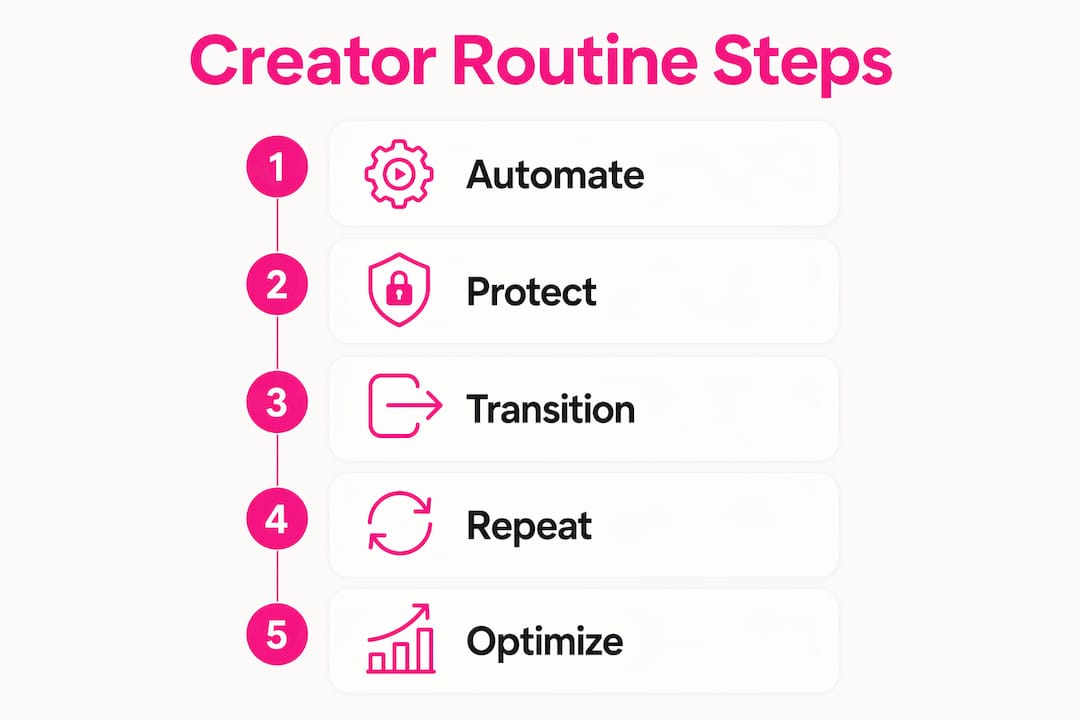
The most effective creator routines share three features: a protected deep work window, a transition ritual, and a system of defaults that removes daily negotiation. Short, consistent daily sessions of 3–4 hours sustain long-term output better than longer sporadic sessions. Mason Currey's research on creative practitioners confirms that modest daily practices accumulate into extraordinary bodies of work over years and decades.
Protect your deep work window
Deep work requires uninterrupted time. A 3–4 hour block, protected from notifications, meetings, and social media, produces more usable creative output than a full day of interrupted work. The key is consistency: same time, same place, same rules. Consistently protected deep work blocks shield creators from distractions and enable the kind of focused mastery that separates good creators from great ones.
Use transition rituals as creative anchors
Nicholas Hobson's research shows that a 5–10 minute pre-work sequence enables effortless entry into creative mode by regulating arousal and goal states. A transition ritual is any brief, repeatable sequence that signals the shift from everyday thinking to focused creation. It functions as a psychological anchor, a cue that tells the brain: this is the time for making things.
Effective transition rituals are short, specific, and sensory. They might include:
- Brewing a specific drink and drinking it before opening any creative file.
- Writing three sentences by hand before touching a keyboard or camera.
- Playing the same instrumental playlist at the start of every session.
- A brief walk around the block before sitting down to create.
Build defaults and constraints
Defaults are decisions made in advance. A creator who decides on Sunday that Monday is always a scripting day, Tuesday is always a filming day, and Wednesday is always an editing day has eliminated three daily decisions before the week begins. Defaults reduce the mental load of the "what should I do today?" question to zero.
Constraints work the same way. Limiting a filming session to two hours forces faster decisions and reduces perfectionism. Limiting a script to 300 words forces clarity. The constraint removes options, and removing options removes the anxiety of choosing between them.
Pro Tip: Test your routine for two weeks before changing it. Most creators abandon routines too early, before the procedural memory has formed and the friction has dropped. Give the structure time to become automatic.
Key Takeaways
Creator routines work better because they convert daily decisions into automatic behavior, freeing mental energy for the creative work that actually requires original thought.
| Point | Details |
|---|---|
| Routines reduce cognitive load | Procedural memory handles repetitive decisions, preserving working memory for creative tasks. |
| Predictability lowers anxiety | Stable schedules shift the brain from threat detection to flexible, divergent thinking. |
| Consistent posting builds trust | Regular schedules improve algorithm visibility and train audiences to return on schedule. |
| Transition rituals reduce startup friction | A 5–10 minute pre-work sequence primes the brain for focused creative output. |
| Defaults prevent burnout | Pre-made decisions eliminate daily negotiation and sustain momentum over the long term. |
Routines as creative containers, not creative cages
I used to think structure was the enemy of spontaneity. I spent years waiting for inspiration to arrive before I started working, and I produced exactly what you would expect: inconsistent output, long dry spells, and a constant low-grade anxiety about whether the next idea would ever show up.
What changed my thinking was watching creators who produced at a high level for years without burning out. None of them waited for inspiration. They showed up at the same time, in the same way, and let the work arrive within the structure they had built. The routine was not the cage. It was the container that gave the creativity somewhere to go.
The most counterintuitive thing I have learned is that creative freedom expands inside a good routine, not outside one. When you stop negotiating with yourself about when and whether to create, you have more mental space for how and what. The daily habit of showing up, even imperfectly, even for a short session, keeps the creative thread alive in a way that sporadic bursts never can.
Consistency beats intensity every time. A creator who produces something every day for a year will outperform a creator who produces something brilliant once a month. The daily practice builds skill, builds audience trust, and builds the kind of creative confidence that no amount of motivation can manufacture. If you are building a beauty creator content practice, the routine is the product as much as the content itself.
— Minwoong
The products that fit your creative practice
Thepicks was built around creators who show up consistently and share what actually works. Every product on the platform has been tested and reviewed by real beauty creators, which means the picks you find there reflect real daily routines, not sponsored guesswork.

If you are building a skincare or beauty routine that supports your creative practice, the creator-curated picks on Thepicks give you a direct line to what working creators actually use. From morning skincare steps to the products that photograph well on camera, the selections are organized by creator so you can shop by trust, not by trend. Creators like Haley Gansel share the exact products that anchor their daily routines, tested on real skin and reviewed with real opinions.
FAQ
Why do creator routines work better than inspiration-based approaches?
Routines automate repetitive decisions through procedural memory, freeing working memory for creative tasks. Inspiration-based approaches require full cognitive engagement every session, which depletes mental energy faster and produces inconsistent output.
How long should a daily creative session be?
Research from Mason Currey's study of creative practitioners shows that 3–4 hours of focused daily work sustains long-term output better than longer sporadic sessions. Shorter, consistent sessions accumulate into significant bodies of work over time.
What is a transition ritual and why does it matter?
A transition ritual is a short, repeatable sequence performed before creative work begins. Nicholas Hobson's research shows a 5–10 minute pre-work sequence reduces startup friction and primes the brain for focused creative output.
How do routines help with content consistency on social platforms?
Consistent posting cycles signal reliability to platform algorithms and train audiences to return on a predictable schedule. Creators with regular posting habits gain better retention and visibility than those who post irregularly.
Can routines actually reduce creative burnout?
Systems and defaults within routines reduce burnout more effectively than motivation because they eliminate daily decision-making. When the "what should I do today?" question is already answered, mental energy stays available for the creative work itself.