
Crowd-sourced beauty picks matter because they turn discovery into confident purchases by combining creator verification with large-scale user evidence. An Allure mid-2026 survey of more than 142,000 readers found that customer reviews (42%) slightly outpace influencer video reviews (41%) in driving beauty purchase decisions. Volition Beauty's crowdsourcing model produced positive month-over-month sales growth after launching community-voted products. Thepicks layers creator testing on top of that community signal, giving US K-beauty shoppers a double filter before they spend.
The core benefits of community beauty picks, at a glance:
- Confidence to buy: Patterns across many reviewers reduce the risk of a mismatch on texture, finish, or shade.
- Better skin-type fit: Reviewer metadata (skin type, routine, frequency of use) maps other people's experience to yours.
- Real-use durability: Long-term reports and "empties" show whether a product holds up past the first week.
Pro Tip: Before reading any review, check the reviewer's skin type. A glowing review from someone with oily skin tells you almost nothing if you have dry, dehydrated skin.
Table of Contents
- What do "crowd-sourced" and "creator-verified" beauty picks actually mean?
- What does the data actually show about crowd-sourced beauty?
- How to evaluate crowd-sourced beauty picks before you buy
- Why creator-led crowdsourcing works especially well for K-beauty
- How Thepicks uses creator and crowd curation for US K-beauty shoppers
- Key Takeaways
- The signal most shoppers underestimate
- Get creator-verified K-beauty picks on Thepicks
- Useful sources
What do "crowd-sourced" and "creator-verified" beauty picks actually mean?
These two terms are often used interchangeably, but they describe different signals that work best together.
Crowd-sourced picks come from community voting, aggregated customer reviews, or crowd-submitted product concepts. The power is in the volume: when dozens or hundreds of shoppers with different skin types, climates, and routines all report the same result, that pattern is hard to fake and hard to dismiss.
Creator-verified picks go a step further. A beauty creator tests a product, documents their skin type and routine, and vouches for it under their name. That single-voice endorsement is closer to a trusted friend's recommendation than an anonymous five-star rating.
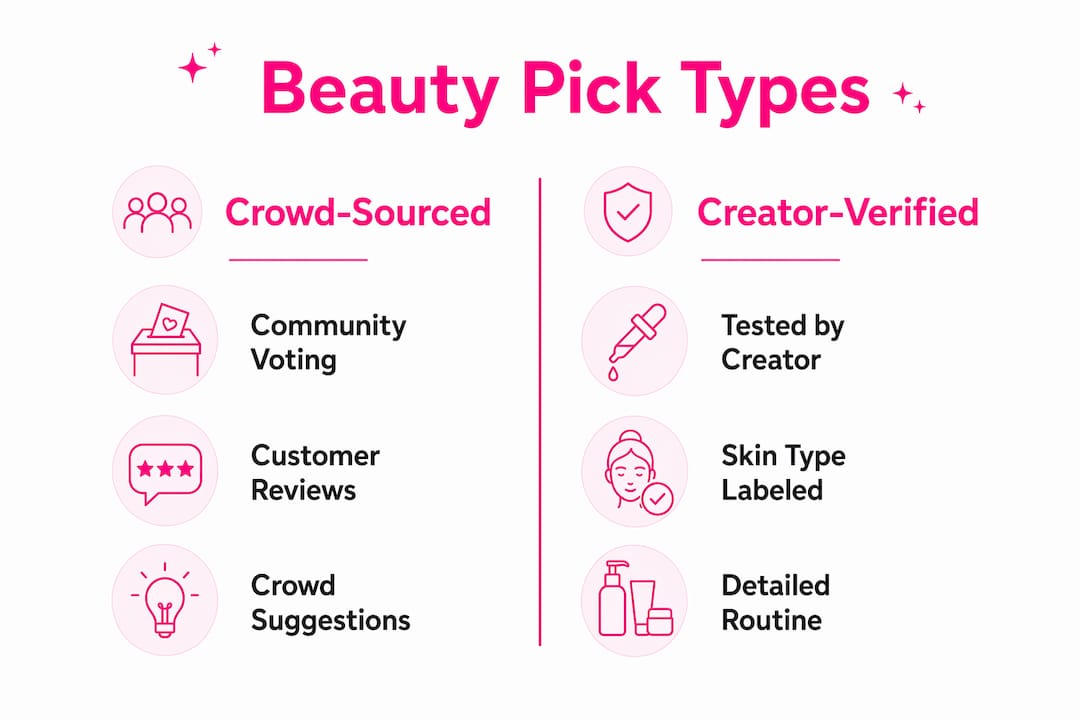
The roles split cleanly: creators surface products worth knowing about, and the crowd confirms whether those products actually work across a range of real people. Beauty communities are increasingly filling the fact-checking role that single influencer endorsements used to own.
Here is how to recognize each signal on a product page or platform:
- "Creator shelf" — a curated collection tied to a named creator who has tested every item on it.
- "Verified creator review" — a review with a creator badge, skin-type label, and routine notes attached.
- "Crowd vote result" — a product that reached launch because a community voted for it, as Volition Beauty's Innovator program demonstrates.
Pro Tip: A "verified creator review" without a skin-type label is weaker than it looks. The label is what lets you decide whether that creator's experience maps to yours.
What does the data actually show about crowd-sourced beauty?
The evidence for community-driven beauty picks comes from multiple directions: survey data, brand-growth research, and a well-documented crowdsourcing case study.

The Allure survey result is the sharpest single data point. Customer reviews edged out influencer video reviews 42% to 41% among more than 142,000 respondents, suggesting that peer validation now rivals creator endorsement as a purchase driver.
The Volition Beauty case is the most concrete proof of concept. Glossy reported that Volition's crowd-submission and voting model produced positive month-over-month sales growth after community-voted products launched. An academic analysis of Volition identified seven co-creation strategies the brand used, including behind-the-scenes content, shared values, and belonging signals, all of which build the community trust that converts browsers into buyers.
| Signal | What it shows |
|---|---|
| Allure survey (142,000+ readers) | Customer reviews (42%) slightly outpace influencer video reviews (41%) |
| 5WPR community-led brand research | Community programs tied to higher conversion and LTV vs. ads alone |
| Volition Beauty crowdsourcing model | Crowd-voted product launches produced positive month-over-month sales growth |
| Academic Volition case study | Seven co-creation strategies build community trust and brand image |
One honest caveat: most of this evidence comes from brands that already had engaged communities. The conversion lift may be smaller for a brand starting from scratch, and sample demographics in some surveys skew toward younger, digitally active shoppers.
How to evaluate crowd-sourced beauty picks before you buy
Not every crowd signal is trustworthy. Here is a practical checklist for K-beauty shoppers.
- Look for reviewer diversity. A product praised by people with oily, dry, and combination skin is a stronger signal than 200 reviews from the same demographic.
- Check reviewer metadata. Skin type, routine steps, and frequency of use turn a subjective opinion into something you can map to your own situation.
- Spot the pattern, not the outlier. One five-star review and one one-star review cancel each other out. Consistent mid-to-high ratings across skin types are what you want.
- Prioritize long-use reports. "Empties" videos and four-week follow-up reviews show whether a product holds up, not just whether it felt nice on day one. Social platforms like TikTok and YouTube have made long-use content a practical fact-checking tool.
- Look for a creator verification label. A named creator with a skin-type note and a routine context is more useful than an anonymous five-star rating.
- Watch for red flags. A sudden spike of five-star reviews with no photos, no detail, and similar posting dates is a manipulation signal. Incentivized reviews should be disclosed; if they are not, treat them with skepticism.
Good crowd signal: Ten reviewers across three skin types all report the same lightweight finish and no pilling when layered under SPF.
Weak crowd signal: Forty five-star reviews posted in the same week, all under 10 words, no photos.
Pro Tip: For K-beauty specifically, search for the Korean ingredient name alongside the product name. Communities on Reddit and dedicated K-beauty forums often have ingredient-level discussions that go deeper than any product page.
Pro Tip: Always patch-test a new K-beauty formula for 24–48 hours before full application, regardless of how many positive reviews you read. Crowd data reduces risk; it does not eliminate it.
Why creator-led crowdsourcing works especially well for K-beauty
K-beauty formulations are genuinely different from Western skincare in ways that make crowd signals more valuable, not less. Textures like watery essences, jelly moisturizers, and sleeping masks behave differently depending on your existing routine, climate, and skin barrier. A product that layers perfectly over a Western toner might pill under a K-beauty essence. Only real-use reports from people running similar routines can tell you that.
Shade and undertone matching is another area where crowd evidence earns its keep. K-beauty color products, particularly cushion foundations and lip tints, often use undertone language that does not map directly to Western shade systems. Multiple community reports from people with similar undertones reduce the mismatch risk significantly.
K-beauty categories that benefit most from crowd signals:
- Essences and ampoules: Absorption speed and layering behavior vary widely by skin type.
- Sheet masks: Fit, serum volume, and post-mask tackiness are all real-use details that product pages skip.
- Cushion foundations: Shade oxidation and finish (dewy vs. matte) change between application and end of day.
- Lip tints: Undertone shift on different skin tones is almost impossible to judge from a swatch photo alone.
Niche K-beauty brands gain traction precisely because communities surface the formulation details that mass-market marketing ignores.
How Thepicks uses creator and crowd curation for US K-beauty shoppers
Thepicks is built around the exact combination this article describes: creator testing plus community feedback, applied specifically to Korean beauty products shipped directly to US shoppers.
Every product on Thepicks has been tested by a beauty creator before it appears on the platform. Creators document their skin type, routine context, and frequency of use, so shoppers can immediately assess whether a creator's experience is relevant to their own. Haley Gansel's creator shelf, for example, gives shoppers a curated collection with the creator's own notes attached to each pick.
The shopper flow on Thepicks works like this:
- Browse a creator shelf to discover products filtered through a creator's real testing.
- Read the creator's notes and metadata on the product page.
- Check community reviews for pattern confirmation across skin types.
- Buy or sample with a clearer picture of how the product will perform for you.
Pro Tip: Start with a creator whose skin type matches yours. On Thepicks, creator shelves are the fastest way to narrow a K-beauty search from hundreds of products to a short list that already fits your routine.
Key Takeaways
Crowd-sourced, creator-verified picks reduce K-beauty purchase risk by combining creator testing with community pattern evidence across diverse skin types.
| Point | Details |
|---|---|
| Reviews rival influencers | Allure's survey of 142,000+ readers found customer reviews (42%) slightly outpace influencer video reviews (41%). |
| Community lifts conversion | Early-2026 research links community-led programs to higher conversion and lifetime value vs. ads alone. |
| Crowd signals need diversity | Consistent results across multiple skin types are a stronger signal than volume alone. |
| Long-use reports matter most | Empties and four-week reviews predict repurchase likelihood better than first-impression posts. |
| Thepicks applies both filters | Creator testing plus community reviews on Thepicks gives US K-beauty shoppers a double signal before they buy. |
The signal most shoppers underestimate
The conventional wisdom treats creator picks and community reviews as competing signals. Pick one or the other. That framing misses the point entirely.
The real value is in the combination. A creator's pick tells you a product is worth considering. Community reviews across diverse skin types tell you whether it will work for you specifically. Neither signal alone closes that gap. A creator with 500,000 followers and one skin type is still one data point. A thousand anonymous reviews with no metadata are noise. Together, they become something closer to a prediction.
What most shoppers underestimate is the metadata. Skin type, routine context, frequency of use: these details are what separate a useful review from a useless one. Platforms that surface this information, and creators who provide it, are doing the work that makes crowd-sourced beauty picks genuinely reliable rather than just popular.
Get creator-verified K-beauty picks on Thepicks
Thepicks gives US shoppers something most K-beauty marketplaces do not: every product has been tested by a real creator, with skin-type notes and routine context attached before it ever reaches your cart. You skip the guesswork of sorting through unverified reviews and go straight to picks that have already been filtered by someone whose skin profile you can actually compare to your own.
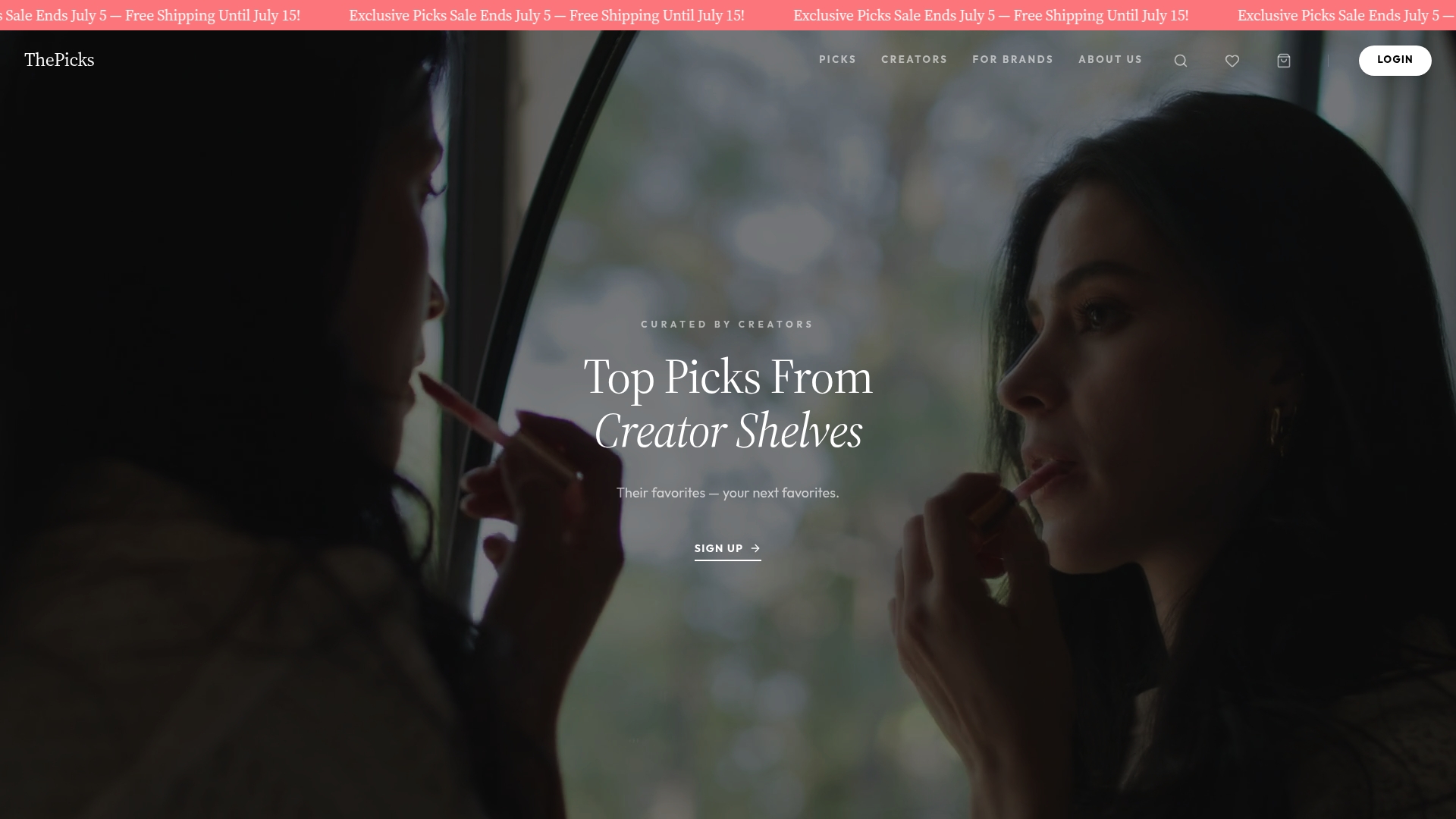
Browse creator-curated K-beauty picks on Thepicks, or go directly to a creator shelf to find products matched to your skin type and routine. US shipping is included on every order.
Useful sources
- Allure Readers' Choice Shopping Influence Survey — Survey data (142,000+ readers) showing customer reviews (42%) slightly outpace influencer video reviews (41%) as purchase drivers. The most direct evidence for why peer validation matters.
- 5WPR: Community-Led Beauty Brand Growth — Industry analysis linking community-led programs to higher conversion and customer lifetime value. Useful for understanding the business case behind community curation.
- Glossy: Crowdsourced Product Development in Indie Beauty — Case study overview of Volition Beauty's crowd-submission model and its sales growth outcomes. The clearest real-world example of crowdsourcing producing results.
- Academic Volition Beauty Case Study (Erasmus University) — Peer-reviewed analysis of Volition's seven co-creation and community engagement strategies. Provides academic validation for the tactics described in this article.
- Glamour: Crowdsourced Beauty Explained — Background on how brands like Glossier used community input to develop hit products. Useful historical context for how crowdsourcing accelerates product-market fit.
- Breanna Beauty: Beauty Communities Replacing Influencers — Industry commentary on the shift from single-voice influencer endorsements to community-driven trust. Supports the discovery vs. fact-checking framework used throughout this article.
- Mamabella: How Social Media Changed Beauty Buying — Trend analysis on how "empties" videos and live Q&A changed long-use evidence standards. Relevant to the checklist section on prioritizing long-use reports.
- Volition Beauty Platform — Direct reference for Volition's Innovator program, crowd voting, and third-party lab formulation pipeline. Used as a concrete model for how crowdsourcing mechanics work in practice.
- Thepicks Creator Shelves — Platform proof of concept: creator-curated K-beauty picks with skin-type metadata and routine context, shipped directly to US shoppers.