
Vegan Korean skincare means products formulated without any animal-derived ingredients and, ideally, produced without animal testing at any stage of development or sale. If you're shopping in the U.S. right now, here's your three-step starting point:
- Verify cruelty-free status by checking Leaping Bunny or PETA's searchable database before trusting any packaging claim.
- Scan the INCI list for animal-derived ingredients like collagen, beeswax, lanolin, or carmine — the full ingredient list never lies the way a front-label claim can.
- Buy from a vetted U.S. seller like Thepicks, where every product is tested and reviewed by real beauty creators before it lands on a shelf.
The K-beauty world has genuinely embraced plant-based formulation, but "made in Korea" does not automatically mean cruelty-free or vegan. That gap is exactly what this guide closes.
Table of Contents
- What do "vegan," "cruelty-free," and "made in Korea" actually mean?
- How to build a simple vegan K-beauty routine
- Which ingredients should you avoid, and what replaces them?
- Vegan-friendly Korean brands and products by category
- Where to buy vegan K-beauty in the U.S. and how to avoid fakes
- How long until you see results, and how do you introduce actives safely?
- How Thepicks vets and curates creator-tested vegan picks
- Key Takeaways
- The case for taking vegan K-beauty seriously
- Creator-tested vegan K-beauty, shipped to your door by Thepicks
- Useful sources for verification and further reading
What do "vegan," "cruelty-free," and "made in Korea" actually mean?
These three labels sound like they belong together. They often don't.
Cruelty-free means no animal testing was conducted on the finished product or its ingredients, anywhere in the supply chain, including by third parties. Leaping Bunny requires brands to commit to this globally, not just in their home market.
Vegan is a separate question entirely. A product is vegan when it contains zero animal-derived ingredients. A cruelty-free brand can still use beeswax, honey, or snail mucin and call itself cruelty-free. Those two claims live on different axes.
"Made in Korea" tells you where the product was manufactured. It says nothing about whether the brand sells in markets that require animal testing. This is where the China caveat comes in.
The China market-testing problem
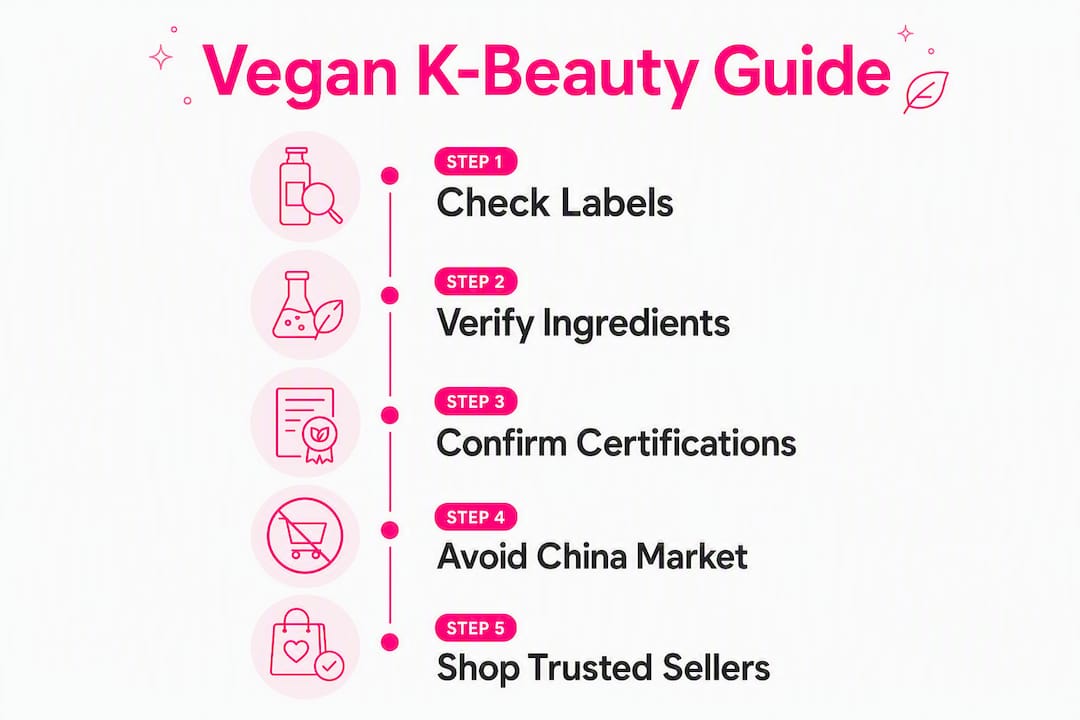
Brands that sell physical cosmetics in mainland China have historically been subject to mandatory post-market animal testing requirements. Leaping Bunny's certification standards require brands to avoid animal testing globally, including any third-party testing triggered by sales in those markets. A Korean brand can manufacture in Seoul and still lose its cruelty-free standing if it distributes through mainland Chinese retail channels.
This matters because several popular K-beauty brands have entered the Chinese market. Always cross-check a brand's current distribution footprint, not just its country of origin.
Certifications worth trusting
Not all seals carry the same weight for U.S. shoppers. Prioritize these:
- Leaping Bunny — the gold standard for cruelty-free; requires annual recommitment and supply-chain audits
- Vegan.org certification — U.S.-based vegan certification body; useful for cross-referencing
The Ethical Bunny K-beauty guide maintains a categorized list that sorts brands into vegan, cruelty-free-but-not-vegan, pending, and blacklisted. It applies stricter methodology than marketing claims by verifying brand responses directly. Bookmark it.
How to build a simple vegan K-beauty routine
The classic K-beauty routine maps cleanly onto vegan formulations. Here's a practical daily and weekly structure:
- Oil cleanser (PM only) — Removes SPF and makeup. Look for plant-oil-based formulas: jojoba, squalane, or sunflower oil. Avoid cleansers with lanolin or beeswax. Use nightly.
- Water-based cleanser (AM and PM) — Gel or foam textures work for oily and combination skin; cream cleansers suit dry or sensitive types. Centella asiatica and green tea are common vegan-friendly actives here.
- Toner or essence (AM and PM) — Hydrating toners with fermented rice water, hyaluronic acid, or niacinamide are almost always vegan. Check for honey or propolis, which appear in some K-beauty toners.
- Serum or treatment (AM and/or PM) — This is where actives live. Vitamin C serums (ascorbic acid, sodium ascorbyl phosphate) are vegan. For a retinol alternative, bakuchiol is plant-derived and increasingly common in K-beauty. Peptide serums are vegan when the peptides are synthetic, which most are.
- Moisturizer (AM and PM) — Gel moisturizers suit oily skin; cream formulas work for dry. Avoid products listing collagen from marine or bovine sources; look for "vegan collagen" or plant-based hyaluronic acid instead.
- Sunscreen (AM only) — Non-negotiable. Chemical and mineral SPFs can both be vegan; check for beeswax in stick formats. For a curated breakdown by skin type, the best Korean sunscreens guide on Thepicks is worth reading before you buy.
- Weekly treatments — Sheet masks, exfoliating pads (AHA/BHA), or wash-off masks. Avoid masks with honey, collagen, or silk proteins. Centella, rice, and green tea masks are reliably plant-based.
Skin-type quick notes:
- Oily/acne-prone: Gel textures, niacinamide serums, BHA exfoliants (salicylic acid is plant-derived)
- Dry/dehydrated: Cream moisturizers, ceramide formulas (check source — plant-derived ceramides exist), hyaluronic acid layering
- Sensitive: Centella asiatica, cica, and oat-based formulas; introduce one new product at a time
Which ingredients should you avoid, and what replaces them?
Animal-derived ingredients hide behind both common names and INCI terminology. Here's what to scan for:
- Collagen — (Soluble Collagen, Hydrolyzed Collagen) — usually bovine or marine; replace with synthetic peptides or "vegan collagen" (plant-derived protein complexes)
Traditional Korean ingredients like fermented botanicals, rice extract, centella, and green tea are almost always vegan-friendly and form the backbone of many plant-based K-beauty formulas.
Pro Tip: When scanning an INCI list, search for "Cera," "Mel," "Collagen," "Sericin," and "CI 75470" first. These five terms catch the most common animal-derived ingredients in K-beauty in under 30 seconds. If any appear, cross-reference with the brand's vegan certification page before buying.

Vegan-friendly Korean brands and products by category
Most Korean brands offer partially vegan lines rather than fully vegan portfolios, so verifying individual SKUs is non-negotiable. The brands below have strong vegan-friendly reputations, but always confirm the specific product's INCI before purchasing.
| Brand | Vegan Status | Best For | Category Strength |
|---|---|---|---|
| SKIN1004 | Largely vegan (Madagascar Centella line widely cited as vegan) | Sensitive, reactive skin | Toners, serums, ampoules |
| Purito | Mostly vegan; verify per SKU | All skin types, SPF focus | Cleansers, sunscreens |
| Beauty of Joseon | Partially vegan; some products use honey/propolis | Dry, dull skin | Serums, sunscreens |
| Isntree | Largely vegan; check moisturizers | Dry, sensitive skin | Toners, moisturizers |
| Klairs | Partially vegan; verify per SKU | Sensitive, acne-prone | Toners, vitamin C serums |
| Axis-Y | Largely vegan; strong INCI transparency | Oily, combination skin | Serums, SPF |
| Bonajour | Mostly vegan; plant-focused formulas | Dry, mature skin | Ampoules, creams |
| Anua | Largely vegan; check specific formulas | Oily, sensitive skin | Toners, cleansers |
By routine step:
- Cleansers: Purito's From Green Cleansing Oil and Anua's Heartleaf Pore Control Cleansing Oil are frequently cited as vegan-friendly. Isntree's Hyaluronic Acid Toner Pad doubles as a gentle exfoliant.
- Toners/essences: SKIN1004's Madagascar Centella Hyalu-Cica Water-Fit Sun Serum line and Klairs' Supple Preparation Unscented Toner are go-to picks. Anua's Heartleaf 77% Soothing Toner is a standout for oily skin.
- Serums: Axis-Y's Dark Spot Correcting Glow Serum and Klairs' Freshly Juiced Vitamin Drop are both widely listed as vegan. Bonajour's Green Tea Watery Cream works as a light treatment layer.
- Moisturizers: Isntree's Hyaluronic Acid Moist Cream and SKIN1004's Madagascar Centella Ampoule Cream are reliable picks. The Ultra Moisturizing Derma Cream with 17 Amino Acids on Thepicks is creator-tested and INCI-verified.
- Sunscreens: Purito's Daily Go-To Sunscreen and Axis-Y's Artless Glow Base SPF 50+ are popular vegan-friendly options. Beauty of Joseon's Relief Sun: Rice + Probiotics is beloved but contains honey derivatives in some formulations, so check the current INCI.
- Weekly treatments: The Firm & Glow Sheet Mask with Vegan Collagen on Thepicks uses plant-derived collagen and biodegradable cellulose. Bonajour's Green Tea Water Bomb Mask is another solid weekly option.
Where to buy vegan K-beauty in the U.S. and how to avoid fakes
Authenticity is a real problem in the K-beauty market, especially on large general marketplaces. Here's how to shop safely:
Trusted seller types:
- Official brand websites that ship to the U.S. directly
- Creator-curated platforms like Thepicks, where products are tested before listing
- Specialty K-beauty retailers with transparent sourcing and return policies
- Certified resellers listed on brand websites
Red flags to walk away from:
- Prices significantly below the brand's own retail price (a $30 serum listed at $8 is almost never real)
- No INCI list on the product page
- Missing seller contact information or a P.O. box as the only address
- Inconsistent packaging photos across listings (different fonts, label placement, or batch codes)
- Marketplace sellers with no review history or reviews that don't mention the product specifically
Practical buying tips:
- Request the batch/lot code from the seller and verify it on CheckFresh or the brand's own batch-check tool
- Compare the INCI list across multiple seller pages; discrepancies often signal a counterfeit or reformulated product
- Prefer U.S.-based fulfillment when possible for easier returns and faster shipping
- Cross-reference brand claims with the Ethical Bunny K-beauty guide before finalizing a purchase
How long until you see results, and how do you introduce actives safely?
Realistic timelines matter. Here's what to expect from a vegan K-beauty routine:
- Days 1–7: Hydration and texture improvements are usually the first thing you notice. A good toner-moisturizer combo can make skin feel softer within a week.
- Weeks 2–6: Barrier repair takes longer. If you're recovering from irritation or overuse of actives, give your skin a full 4–6 weeks of a gentle, hydration-focused routine before adding anything stronger.
- Weeks 6–12: This is when vitamin C, bakuchiol, and AHA/BHA exfoliants start showing visible results on tone, texture, and fine lines. Don't judge an active before the 8-week mark.
Patch-testing procedure:
- Apply a small amount of the new product to the inner forearm or behind the ear
- Leave it for 48–72 hours without washing the area
- Any redness, itching, or swelling means stop use; no reaction means you're likely safe to apply to your face
- Even after a clean patch test, introduce one new product at a time, spaced at least one week apart
Safe order of introduction for actives:
- Start with vitamin C (AM) once your barrier feels stable
- Add bakuchiol (PM) as your retinol alternative; it's gentler and pairs well with moisturizers
- Introduce AHA or BHA exfoliants last, no more than 2–3 times per week
- Always follow actives with moisturizer and, in the morning, SPF 30 or higher
How Thepicks vets and curates creator-tested vegan picks
Every product on Thepicks goes through a vetting process before it reaches a creator shelf. The methodology covers four areas:
- Creator testing: Real beauty creators use products over time and across skin types before recommending them, not just for a single application
- INCI transparency checks: Product pages list full ingredient information so shoppers can verify vegan and cruelty-free claims themselves
- Certification verification: Thepicks cross-checks brand certification status against Leaping Bunny, PETA, and The Vegan Society listings
- Seller authenticity: Products are sourced through verified channels, reducing the counterfeit risk that comes with large general marketplaces
A few creator-tested picks worth knowing:
- The Firm & Glow Sheet Mask with Vegan Collagen passed vetting for its plant-derived collagen claim, biodegradable sheet material, and visible firming results across multiple skin types
- The Ultra Moisturizing Derma Cream with 17 Amino Acids was flagged by creators for its barrier-repair performance on dry and sensitive skin, with a clean INCI that confirmed vegan status
- Creator shelves like Lutimila Veukiso's picks and Haley Gansel's picks organize products by skin concern, making it easier to find vegan options that match your specific needs
Pro Tip: When a creator has been using a product for 8–12 weeks and still recommends it, that's a stronger signal than a first-impression review. On Thepicks, look for picks that include long-term use notes, not just first-impression reactions.
Key Takeaways
Verified vegan Korean skincare requires checking both the INCI list and a recognized third-party certification, because "cruelty-free" and "vegan" are separate claims that packaging often conflates.
| Point | Details |
|---|---|
| Vegan ≠ cruelty-free | Confirm both claims separately: INCI for ingredients, Leaping Bunny or PETA for testing status. |
| China market caveat | Brands selling in mainland China may trigger testing requirements that void cruelty-free status. |
| Certifications to prioritize | Leaping Bunny, PETA, and The Vegan Society are the most verifiable seals for U.S. shoppers. |
| Results take time | Expect hydration changes in days, barrier repair in 2–6 weeks, and active ingredient results in 6–12 weeks. |
| Thepicks for vetted picks | Thepicks ships creator-tested, INCI-verified Korean skincare directly to U.S. shoppers. |
The case for taking vegan K-beauty seriously
The conversation around vegan K-beauty tends to get stuck in two places: either it's treated as a niche ethical preference, or it's dismissed as marketing. Both framings miss what's actually interesting here.
Korean skincare has always leaned heavily on fermentation, botanical extracts, and traditional plant ingredients. Rice water, green tea, centella asiatica, and fermented yeast filtrates were vegan long before "vegan beauty" became a category. The shift happening now is that formulators are replacing the genuinely animal-derived components, like snail mucin, collagen, and honey, with plant-derived or lab-synthesized alternatives that perform just as well. Vegan collagen analogues and synthetic peptides are not compromises; they're often more stable and better absorbed than their animal-derived counterparts.
What I think gets underestimated is the verification gap. A brand can market itself as "clean" or "natural" and still use lanolin or carmine. The only way to close that gap is to read the INCI list and check a third-party certification. No shortcut replaces those two steps. Thepicks exists partly to do that work upstream, so the products that reach creator shelves have already been checked. That's a different model from browsing a general marketplace and hoping the listing is accurate.
The brands worth watching in 2026 are the ones building fully vegan portfolios from the ground up, not just flagging individual SKUs. SKIN1004 and Axis-Y are already moving in that direction. The rest of the market will follow.
Creator-tested vegan K-beauty, shipped to your door by Thepicks
Sorting through certification databases, INCI lists, and seller reviews takes time most shoppers don't have. Thepicks cuts that process down by doing the vetting before the product ever reaches a creator shelf.

Every product on Thepicks is tested by real beauty creators, INCI-verified, and shipped directly to U.S. customers. You get creator reviews that reflect weeks of actual use, not sponsored first impressions. The curated creator shelves organize picks by skin type and concern, so finding a vegan routine that fits your skin doesn't require a spreadsheet. For shoppers who want extra safety verification, the EWG Verified Set is a strong starting point. Browse the creator picks, find your routine, and check out with confidence that what you're getting is the real thing.
Useful sources for verification and further reading
These are the primary authority pages used to verify claims in this guide:
- Leaping Bunny — The gold standard for cruelty-free certification; use the brand search to check current status before buying.
- PETA's cruelty-free company search — Searchable database covering both cruelty-free and vegan designations.
- Vegan.org certification — U.S.-based vegan certification body; useful for cross-referencing vegan claims on Korean brands with U.S. distribution.
- Ethical Bunny K-beauty guide — Community-maintained, methodology-driven categorization of K-beauty brands by cruelty-free and vegan status.
- Thepicks creator shelves — Creator-tested, INCI-verified Korean skincare and makeup shipped to U.S. shoppers.
| Resource | What It Covers |
|---|---|
| Leaping Bunny | Cruelty-free certification with global supply-chain audits |
| PETA Beauty Without Bunnies | Cruelty-free and vegan brand database, searchable by name |
| Vegan.org | U.S.-based vegan product certification and brand registry |
| Ethical Bunny | K-beauty-specific brand categorization with methodology notes |
| Thepicks | Creator-curated, vetted Korean skincare available in the U.S. |